
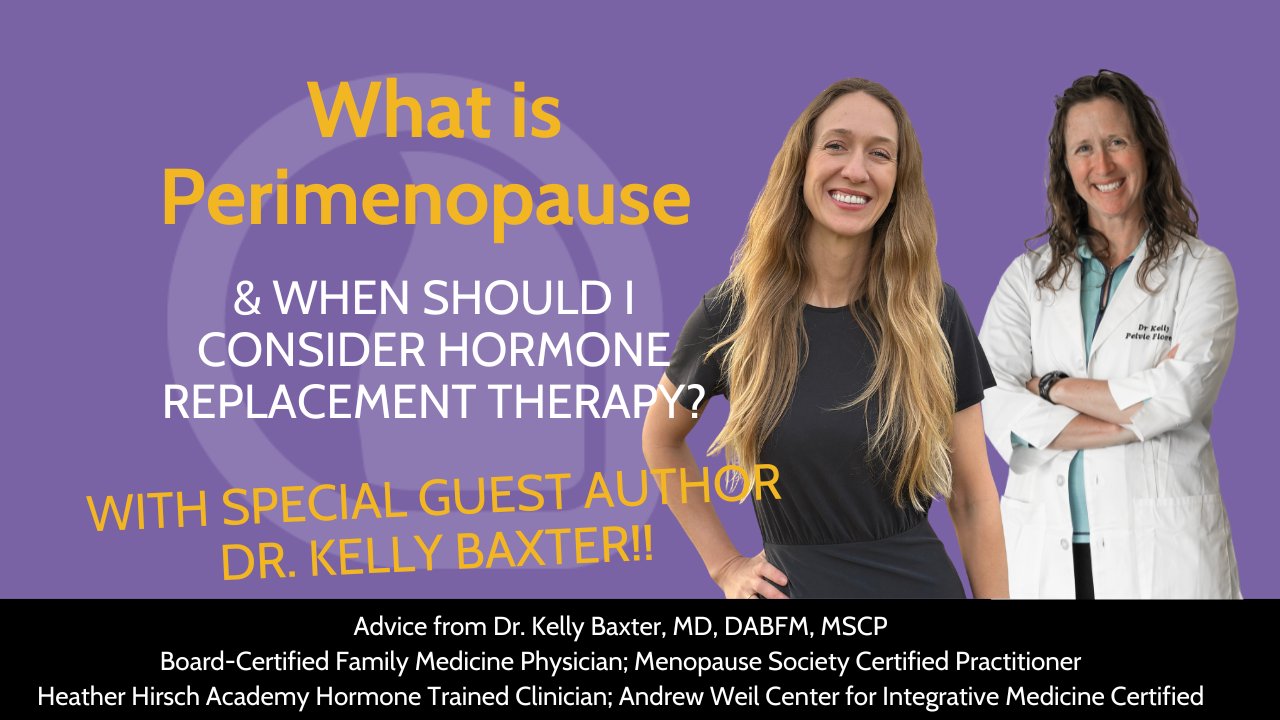
What is Perimenopause & When To Consider Hormone Replacement Therapy
Dec 08, 2025Perimenopause: What’s Happening & When to Consider Hormone Therapy
By Special Guest Blog Author: Dr. Kelly Baxter, MD, DABFM, MSCP
Introducing a Special Guest Blog Author!!
Hi Everyone, It's Dr. Kelly Sadauckas, here to introduce a very special guest blog author, Dr. Kelly Baxter, MD, DABFM, MSCP. All those fancy letters after her Medical Doctor mean that she is a Board-Certified Family Medicine Physician, and a Menopause Society Certified Practitioner. So she knows her stuff She's also a Heather Hirsch Academy Hormone Trained Clinician AND Andrew Weil Center for Integrative Medicine Certified...so what that means is that NOT ONLY is she a bad-ass doctor, she is a super-geek, just like me, and wants to teach YOU about your amazing body, especially hormones, perimenopause (and menopause), and how and when hormone replacement therapy might be right for you!
Dr. Kelly is devoted to helping women feel their best throughout their whole life, and especially through their menopause transition. She specializes in preventative health, hormone therapy AND non-hormone therapy treatment options. She has a special interest in caring for women who experience menopause due to medical conditions, and is committed to advancing education, access to appropriate therapies, and supportive care--especially for breast cancer survivors. If this describes YOU, stick around at the end of the blog, where we tell you how to reach out to her for a consultation or appointment!!
Now... without further ado---allow me to hand over the blog to the FABULOUS Dr. Kelly Baxter!!!
What Is Perimenopause?
Perimenopause is the 7–10 years leading up to menopause (which typically occurs between ages 45–55). Symptoms can begin in your mid-to-late 30s and often get missed or misdiagnosed.
Common symptoms of perimenopause include:
● Poor sleep (quality and quantity, frequently waking)
● Mood changes-anxiety, irritability, depression
● Cognitive changes- brain fog, difficulty with word finding, worsening ADHD symptoms
● Insulin resistance (prediabetes, diabetes)
● Weight gain
● Increasing blood pressure
● Irregular heart beat (palpitations)
● Irregular vaginal bleeding - varying cycle length, more bleeding, less bleeding
● Hot flashes, night sweats
● Tingling in your extremities, ringing in your ears
● Joint pain, frozen shoulder, increased risk for injuries
● Low libido, difficulty achieving orgasm
● Vaginal symptoms- skin changes, dryness, pain, other
● Gastrointestinal symptoms- reflux, bloating, constipation, diarrhea, new food intolerances
● Dry eyes, dry skin, hair loss
● Frequent urinary tract infections and vaginal infections (yeast and bacterial vaginosis)
● And more...
Unfortunately, women commonly receive expensive workups, are placed on multiple medications, and will see on average 5-7 practitioners before being properly diagnosed and treated for perimenopause. Why? Because there have been decades of misinformation, lack of practitioner education, lack of research, and a lack of prioritization of women’s health that has led to a huge knowledge gap– that leaves millions of women suffering unnecessarily.
The Good News is that we are presently in a new era for perimenopause care:
● Research and education on women’s midlife health are expanding
● FDA-approved bioidentical and synthetic treatment options are widely available
● Hormone therapy (HRT) is safer and more effective than many realize, AND the black box warning on many HRT has JUST BEEN REMOVED!!!
Hormone therapy can:
● Ease symptoms
● Improve sleep, mood, and quality of life
● Reduce risk of osteoporosis, cardiovascular disease, diabetes, all-cause mortality, and more (especially when started <10 years from menopause or in perimenopause)
When to Start Hormone Replacement Therapy for Perimenopause
While hot flashes are certainly a flag that your estrogen is low, you don’t need to wait for hot flashes to start HRT. Other symptoms matter too. If you are experiencing symptoms that you would like help with, then you should talk to an experienced practitioner about your individualized risks, benefits, and options.
In fact, one recent study showed that many women reported a general symptom of "just not feeling like themselves" as the number one initial symptom of perimenopause!
Types of Hormone Replacement Therapy for Perimenopause: Bioidentical vs. Synthetic
Bioidentical Hormones
Bioidentical hormones are chemically identical to your natural hormones and generally safer (low risk or no blood clot risk, no proven breast cancer link). Bioidentical hormones are readily available at your local pharmacy in many different formulations and will be called estradiol, progesterone, or testosterone.
Estradiol comes in tablets, patches, gel, mist, vaginal cream, and vaginal inserts. There may be other forms of bioidentical estrogens available through a compounding pharmacy.
Progesterone is a pill only.
Testosterone is most often used as a transdermal gel or cream.
Synthetic Hormones
Synthetic hormones (like those in birth control) are created to be strong enough to suppress ovulation, which can help balance hormones in perimenopause.
Some synthetic hormones also do a better job of controlling heavy bleeding in perimenopause, so may be a great option and can be combined with bioidentical products if needed.
Synthetic hormones may have different side effects and risks, though risks are low for most women. These are also readily available, but will have different names such as ethinyl estradiol, norethindrone, levonorgesterol, and many others. These also come in many different formulations.
What Type of Hormone Replacement Therapy is Best for Perimenopause? Using my normal pharmacy, compounding pharmacy, or pellets?
There is a misconception that to get bioidentical products you need to use a compounding pharmacy.
This is absolutely not true and in fact, there have been FDA approved bioidentical hormone options for a long time that have excellent safety data, are highly regulated, and are commonly covered by your insurance.
Compounding pharmacies are not universally regulated and while some create high quality products and get third party testing, this is not always the case.
Always make sure you use a compounding pharmacy that completes this type of testing. These types of pharmacies are helpful if you have an allergy to peanuts (do not use FDA approved progesterone), for specialty formulations and individualized dosing, and for products that are not available through your traditional pharmacy.
Pellet therapy is an invasive form of hormone therapy that is commonly much more expensive, not FDA approved, requires placement of a pellet that cannot be removed if there are issues, and commonly causes big fluctuations in hormones over the months it is placed.
I generally do not recommend pellet therapy, but if you are happy with yours, trust your practitioner, and have safe levels on your lab work then this might be an ok option for you for now.
Key Considerations When Starting Hormone Replacement Therapy for Perimenopause.
● Still have a uterus? You can be on progesterone alone, but not estrogen alone.
Progesterone helps protect the uterine lining and is always combined with estrogen if
you still have a uterus.
● Sleep issues? Bioidentical progesterone helps with sleep and anxiety—great even
without a uterus. Bioidentical estrogen is also important when it comes to sleep.
● Heavy periods? Make sure to tell your practitioner (sometimes further evaluation is
needed). IUDs or progestin-only methods can help manage bleeding. Bioidentical
progesterone might not be strong enough to control heavier bleeding.
● Pregnancy prevention? It's still possible to get pregnant in perimenopause. We
typically prefer progestin only options like the IUD or mini-pill, which allows you to add a
bioidentical option to treat symptoms if needed as well.
● What is the safest form of birth control? Vasectomy!
● Vaginal dryness, UTIs, or pain? Systemic estrogen might do the trick, but if not (or
depending on your age) vaginal estrogen or DHEA (a precursor to estrogen and testosterone) might be a great choice—and are safe for long-term use, even into your 90s!
● Low libido? This is a complicated one. There are MANY factors that go into wanting
and enjoying sex like body image, your health, your relationship, your hormones, stress,
sleep, LIFE, and so much more.
Low libido is a common issue in perimenopause and menopause so we know hormones can play a big role. Replacing estrogen and testosterone can both be helpful and vaginal hormones may be important if you are having vaginal dryness, pain, and other symptoms. It might take a team based approach (pelvic PT, medical practitioner, mental health practitioner, etc) depending on the person and their individual needs, but if it matters to you, it matters to us!
What is this About Estrogen Dominance During Perimenopause?
While this is not an officially recognized medical term, it is true that at times in the cycle you will have higher than usual estrogen to progesterone ratios. It is not quite that straightforward
however. We naturally are in an estrogen dominant state in the follicular phase (first half) of our cycle as progesterone is only produced in the luteal (second half) of the menstrual cycle and this does not always cause symptoms for women.
The problem is that progesterone levels gradually decline through perimenopause, but estrogen will cycle to much higher levels than it was AND much lower levels, so women are symptomatic from high estrogen, low estrogen, low progesterone, as well as decreasing testosterone.
When thinking about hormone therapy in perimenopause, I generally will start with progesterone to help control vaginal bleeding and to help with sleep and mood. Then I may add estradiol (bioidentical estrogen) if you're dealing with hot flashes, night sweats, joint pain, brain fog, vaginal dryness, and other low estrogen symptoms.
Titrating and finding the right fit during perimenopause can sometimes be difficult. What worked for you before might not work anymore as natural hormone levels change. The good news is there are many available formulations and hormone types through your pharmacy or if needed, through a high quality compounding pharmacy.
Bottom Line for Hormone Replacement Therapy in Perimenopause
You don’t have to suffer through perimenopause. The right hormones—at the right time and dose—can be life-changing. Seek out informed practitioners, stay educated, and don’t settle if your practitioner is not up to date in treating perimenopause, menopause, or using hormone therapy. Every woman deserves an educated discussion about individual risks, benefits, and options so that she can make a decision that is right for her.
For more information:
Follow Ovella Health on Instagram @ovellahealth
Visit Ovella Health's website at www.ovellahealth.com
Sign up for Ovella Health's newsletter HERE
Ovella Health hosts free educational events for communities, patients, and practitioners. Follow them on Instagram for upcoming events, webinars, courses, and more!
Dr. Kelly & Dr. Kelsey are now accepting new patients in CO, MT, ID, and WY-
book a FREE 15 min Discovery Call on their website or sign up as a new client today.
-------------------
WOW!!! THANK YOU, Dr. Kelly Baxter of Ovella Health, for that AMAZING Blog post about Perimenopause and HRT!!!
Pelvic Floored VIPs (Very Important Pelvises), what questions do you have for me, or Dr. Baxter? What other topics are you excited to learn about? Let us know at [email protected] with the subject line Blog Topic Request! And as always, if you enjoyed this post, please share it to your socials and tell your friends and family!! We appreciate you!!
Until next time,
XOXO
Dr. Kelly 💋
Find a Pelvic PT Near You
Schedule an Appointment in-person or online!
Follow on Instagram

For every four online courses sold, one is donated to someone in need through our People Before Profits program. LEARN MORE
SUBSCRIBE FOR WEEKLY LIFE LESSONS
We hate SPAM. We will never sell your information, for any reason.
