
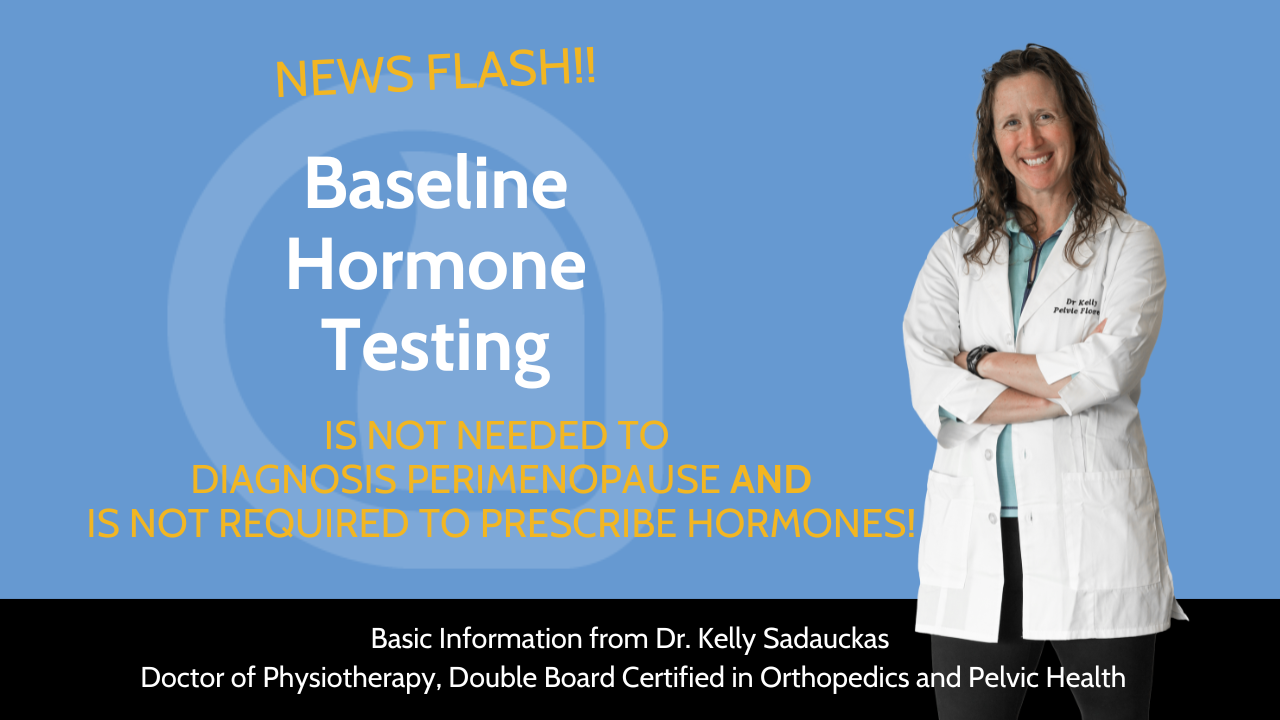
Do I need baseline hormone levels before HRT?
Jun 29, 2026Did you know that a recent study found that only 6.8% of new graduating physicians in OBGYN, Family Medicine and Internal Medicine were up to date and confident in current guidelines for HRT prescriptions?
Isn't that wild!?! And if "new graduates" are only 6.8% proficient, for currently practicing physicians, who have LOTS on their plates, the percentages are likely even less! The implication of that is that your primary provider, whom you love, and who is FABULOUS for your general health needs, might NOT be the ideal provider to manage your hormones, and honestly, might be giving you out-dated advice without realizing how out-of-date it is.
This is NOT a physician-hate-post. I LOVE physicians. They save lives every day, in the way that I save pelvises.
But the fact of the matter is that there are many primary care providers out there right now who aren't up to date on current HRT prescribing evidence or practicalities. Who do I LOVE? Ovella Health (if you are in CO, WY, ID and MT), Gunderson Medicine, and anyone that The Menopause Society recommends :). Those providers have undergone extensive additional training in hormones, and are "to be trusted" with your hormones.
This post is part of a series of posts giving YOU some baseline evidence and knowledge around some of THE MOST COMMON QUESTIONS I am asked about HRT, and the most common myths that I have to DEBUNK about HRT, on a near-daily basis. So let's get to it:
First: Who Am I?
Hi :). I'm Dr. Kelly Sadauckas. Pelvic Floor Physical Therapist, DOUBLE board certified in Women's Health and Orthopedics. I see clients in person and online, all over the world. I am not a prescriber of hormones, but here to offer you basic information about HRT. The Mission of my company, Pelvic Floored, is to remove geographic, financial and psychosocial barriers to kick butt pelvic health care and information.
I have to debunk myths surrounding HRT EVERY DAY in my practice. Due to this huge need for better information, this blog, and a future HRT series, is a HUGE step towards reducing barriers to kick-butt pelvic health care and information. So, to the question at hand:
Do I need baseline hormone levels before starting HRT?
This is one of the most common questions I receive, and the answer varies between "no" and "not necessarily." Here's the rationale.
Perimenopause diagnosed is based on symptoms, not labs.
The Endocrine Society has published that circulating levels of hormones do not necessarily correlate with symptoms. This means that if a provider who is not super well versed in ordering the test is "reading the test", your "numbers" could be within a normal range, but that doesn't mean they can't be optimized.
Menopause and perimenopause professionals recognize the symptom of "just not feeling like yourself" as the FIRST sign of perimenopause. This will happen LONG BEFORE periods change (or if you've had a hysterectomy but still have ovaries, you will never have a period changes to signal perimenopause).
The most important thing to understand is that hormone testing is not needed to diagnose perimenopause, and it is NOT RECOMMENDED by ANY major guideline.
Let's repeat that, for those in the back:
Hormone Testing is NOT RECOMMENDED by any major perimenopausal treatment guideline
Not only is it NOT recommended, but baseline hormone testing can actually cause issues, with patients being told their "hormones are normal", when in fact they are not. In real life, patients rarely feel empowered by hormone testing levels.
In reality, if you do a baseline hormone level testing panel, that test only tells you your hormones are doing on that exact date and time. That is it. It won't tell you what happens the rest of the month.
If you DO choose to have baseline tests done...
While this is NOT recommended, if you DO choose to have baseline tests done, please note the specific day of your cycle that you tested on, so you can have a better understanding of the hormones. As the hormones fluctuate within each cycle (and within each day, TBH), a test done on day 2 (just after you start bleeding) will have very different "expected normative hormone levels" than one done on day 14 (around ovulation). And if you want to compare "apples to apples", you need to be sure that your blood tests for baseline is done on the same day as any follow up testing.
Perimenopause diagnosed is based on symptoms, not labs.
In perimenopause, your labs will fluctuate drastically throughout the month, more so than with normal cycles. This is because the body responding to decreased egg supply, decreased estrogen (on certain days of the month only), and decreased inhibin B. Sometimes your estrogen can be much higher than it was in your 20's, sometimes much lower. Capturing this with a single blood draw is very challenging, and that's why baseline testing is not recommended.
If baseline hormone testing is NOT recommended, what are better tests to run?
I'm so glad you asked!! Instead of baseline hormone testing, which is not recommended by any perimenopause or menopause guideline, there ARE other tests that give you important information about your health. The tests that ARE recommended are:
Thyroid Function
A Thyroid Panel should include TSH, Free T3, Free T4, Reverse T3 and TPO. Just one thyroid test does not give you a full picture!!
Iron Levels!
As with TSH, "one value is mostly meaningless"! In addition to your standard "complete blood count" which will tell you the number of Red Blood Cells, additional specific Iron tests of serum iron, ferritin, as well as potentially Total Iron-Binding Capacity & Transferrin Saturation will give you a much deeper picture into how your body is using and storing Iron.
Ferritin levels will drop BEFORE hemoglobin drops, so you can be iron deficient, but not "anemic"...but if it is not caught, you could later become anemic. Iron is a part of EVERY STEP in the energy production cascade, so it is VITAL that ferritin is not deficient. And if you, like me, suffered from heavy bleeding for a time, it is likely that the ferritin is less than ideal. Note: levels below 30 are considered iron deficient, and "ideal targets" for active women are >50.
Cholesterol Levels
These can indicate if other parts of our diet need improving, or if you have a genetic predisposition to "less than ideal" blood levels :) As with Iron and Thyroid, there are additional tests than "just" HDL and LDL. A more in-depth panel will also look at the size of your LDL, which is fascinating, and your doctor will order that, if they believe it is necessary.
Insulin Resistance
Insulin is a vital hormone, produced by our pancreas, that allows our tissues to absorb glucose (sugar, energy) from the blood stream.
You would want your fasting blood sugar, A1C and insulin levels all checked, to have a picture of how you are doing.
If we are highly stressed ALL THE TIME, or eat a LOT of sugary foods, or have a genetic disposition, we could develop insulin resistance, which is not a good thing. Addressing root causes of this resistance is vital to thriving in perimenopause, and life!
Do I need regular follow up hormone level testing?
This is a GREAT question!
Baseline and follow up testing ARE recommended if you have a vagina and are on Testosterone replacement therapy. This testing is done to ensure that you don't reach "supra therapeutic levels", which is fancy speak for, we don't want "traditional masculine" traits to emerge.
If these supra physiologic levels occur, they can cause irreversible changes like a deepening voice, or even facial hair. So using an FDA Testosterone cream or gel is recommended over pellets or compounded creams, which are not as regulated.
For other hormones, as we discussed above, blood lab values have limited value due the severe fluctuations minute-by-minute. If you decide to do testing, make sure it is with a provider that understands how to read the tests, know what day of your cycle you were on, so that you can be consistent and understand fluctuations in case a later test is done on a different part of the cycle. (Day 1 is when you first bleed). You can then use these levels, in conjunction with how you are feeling and your own personal risk profile, to determine if any changes need to be made with your protocol. BUT LABS ARE NOT REQUIRED in order to diagnosis you with perimenopause or to be used as a reason to not provide HRT.
If you ARE doing hormone labs, for ANY reason, make sure it is with someone who understands the timing and limitations of testing.
You do not have to wait to treat until labs are abnormal, diagnosis is based on symptoms. So if your provider tells you "your fine based on your labs" and "you don't need HRT", but you don't feel fine...then you need to get to a new provider who is more up to date on HRT and realizes that diagnosing perimenopause is NOT done via labs, but is done via symptoms.
You do NOT need to wait for an abnormal lab value to be offered HRT prescriptions.
How do you find a practitioner trained in HRT?
Great question! You can locate a provider near you, by searching any of the following places:
How much HRT do I need?
This is a question for you to discuss with your hormone specialist. It will depend on your specific symptoms, your personal medical history, as well as your genetic (family) health history.
A New England Journal of Medicine article by Davis in 2024 stated that the goal of HRT is to replace hormone levels to premenopausal levels...but in reality the goal of HRT is to "fill in the potholes" of the hormones, so that we don't have excessively low levels.
In reality, a provider will treat your symptoms, and not necessarily try to get you to the highest level of hormones possible. We are looking to optimize your quality of life, not be tied to a test number value.
Once you are on HRT, is there a certain time allowed before you "have to come off"?
NO!!! This is a common misunderstanding about HRT, that you "want to get off of it as quickly as possible."
Remember the goal is to "fill in the potholes" and eliminate the "lowest of the low" hormone level fluctuations, and in doing so, eliminate any negative symptoms associated with those dips or imbalances.
Once you find "your sweet spot" with your referring provider, that is often where you will stay for a period of time. In perimenopause this level might need to be adjusted as your symptoms change, but in menopause, the ideal prescription for you may be more stable.
One caveat is if you develop a hormone sensitive breast cancer, you would need to stop or change HRT. This would be a specific conversation with your hormone specialist and oncologist.
Is it dangerous to be on HRT for a prolonged period?
On the contrary, when you are able to start HRT during the time of fluctuations and initial loss, nearly all health metrics improve.
In fact, prior to menopause, women's cardiovascular system's are MORE resilient than mens. After menopause, we are suddenly "the same." Doesn't it make sense to keep our protective vibes going?
My doctor told me it "was too late" to start HRT. Is that true?
This is a tricky topic, as it 100% depends on your personal medical history. What I will say, is that if your doctor has told you this, but they are NOT a specific hormone specialist (like Ovella, or someone listed on the Menopause Society's page), then you owe it to yourself, and your family, to meet with a hormone specialist.
In "the olden days", women would be told that if they've been menopausal for X number of years, then "it's too late" to start HRT. This is due to an unfortunate misinterpretation/over simplification of an amazing 1990s-early 2000s study (WHI). But that's for another post.
There are MANY caveats to this, but the key is that it is NOT as black or white as "you HAVE to start HRT within THIS MANY DAYS of your last period." So if your provider makes it seem black and white, and they're not a hormone specialist, talk to a hormone specialist :). Still keep your primary provider for general stuff, but let a hormone specialist manage the hormones.
What other questions do you have about HRT?
I provided this blog post to answer many of the GENERAL questions I get about HRT, and common myths that I have to dispel on a daily basis.
How did I do?
Please comment below with any other questions you may have, and be sure to follow me on social media, or join my e-newsletter, for other free awesome (and fun) pelvic health tips.
Thanks for being here!
XOXO
Dr. Kelly 💋
It's true, you can look it up!!
- 2019 study about hormonal competency in new grad MDs: https://pubmed.ncbi.nlm.
nih.gov/30711122 -
The Global Consensus Position Statement explicitly states that total testosterone should not be used to diagnose HSDD, and the role of monitoring is primarily to screen for overuse and supraphysiological levels — not to titrate to a target. Davis SR, Baber R, Panay N, et al. "Global Consensus Position Statement on the Use of Testosterone Therapy for Women." J Clin Endocrinol Metab. 2019.
-
The Endocrine Society notes that between-woman variability in testosterone levels is enormous, and circulating Testosterone levels do not reliably distinguish symptomatic from asymptomatic women. The overlap between normal and low ranges is substantial.
Androgen Therapy in Women: A Reappraisal: An Endocrine Society Clinical Practice Guideline. The Journal of Clinical Endocrinology and Metabolism. 2014. Wierman ME, Arlt W, Basson R, et al.Guideline
-
In clinical trials, the 300 μg/d transdermal testosterone patch produced benefit at doses that achieved high-normal premenopausal free T levels, but the 450 μg/d dose (which produced supraphysiological total T) did not show additional benefit — suggesting a ceiling effect rather than a dose-response relationship.
Sexual Dysfunction in Women. The New England Journal of Medicine. 2024. Davis SR.Review
Testosterone for the Treatment of Hypoactive Sexual Desire Disorder in Perimenopausal and Postmenopausal Women. Obstetrics and Gynecology. 2025. Kling JM.Recent
SUBSCRIBE FOR WEEKLY LIFE LESSONS
We hate SPAM. We will never sell your information, for any reason.
